Run The OpenHands Harness
Start with the basics by running a request and viewing the trace.
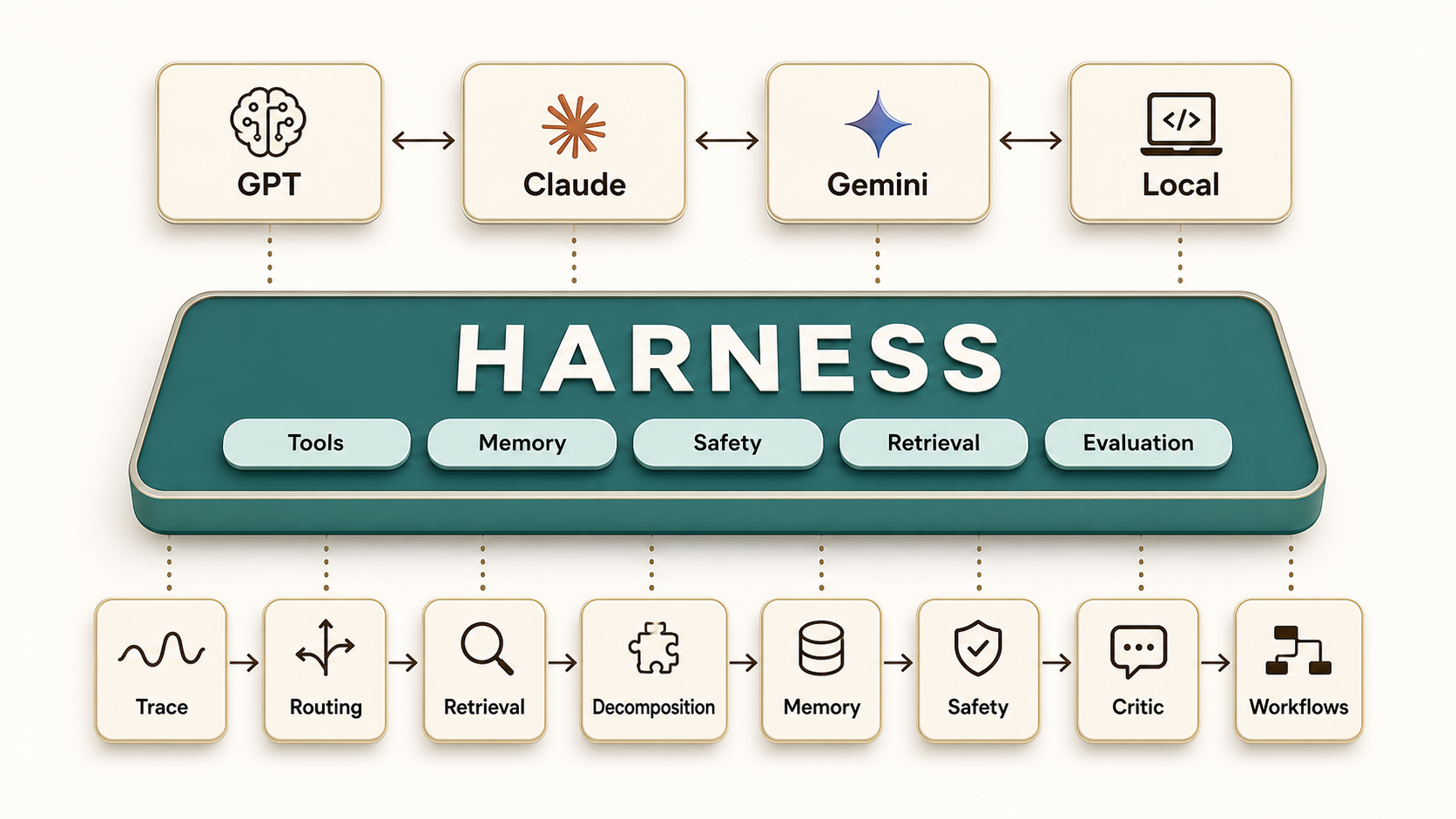
Agent = Model + Harness. A hands-on course for the system around the model: routing, tools, memory, safety, critics, traces, metrics, and workflow design.
Prompt in, text out.
Agent = Model + Harness · the course in one visual
One task. Eight versions of the agent around the same model. Scroll the harness into view.
This site is the guide: what to watch first, what to read, which files to open, and how the pieces connect. The deeper richer exercises live in the GitHub repo.
Harness engineering is the work around the model. The model writes code. The harness decides what the model sees, which tools it can use, what it remembers, what it can break, how work is verified, which model gets called, and when the loop stops. See the harness engineering experiments repo and the blog post for the deeper argument behind this course.
Start with the harness engineering framing, the Visual Intro, the talk, and the experiments that show why harness design matters as much as model capability.
Work through P01 to P12. Each project changes one harness lever and asks you to inspect the trace before keeping the policy.
This is not a general prompt engineering course. It is not about copying and pasting the latest skill. It is designed to help you understand the core principles behind modern coding agents and harnesses. The examples are built so you can see the effect of each choice, which is more useful than only reading about it.
You use:
The goal is not to memorize APIs. The goal is deeper understanding, so on your next project you know which harness levers to pull to solve your problem.